Introduction
There are moments when life asks us to look again.
Sometimes the invitation is gentle. A familiar street in different light. A conversation that stays with us longer than expected. The sudden realization that something we have been worrying about has taken up far more of the day than the thing itself.
At other times, life is less subtle. Someone leaves. A plan fails. The body changes. An old regret returns. We reach the end of something we thought would last much longer, or find ourselves standing at the beginning of something we are no longer certain we are brave enough to enter.
Most of us move through these moments as best we can. We hold on. We push forward. We make plans. We replay conversations. We imagine what might happen next. We try to repair what can be repaired and sometimes keep trying long after repair is no longer what is needed.
And every so often, something interrupts that momentum.
A question.
A pause.
A different way of seeing what has been in front of us all along.
That is where the stories in this book live.
They are stories about people trying to make sense of change, uncertainty, love, disappointment, aging, fear, responsibility, grief, ambition, forgiveness, and the thousand small choices that slowly become a life. Some of them are facing moments that will alter everything. Others are dealing with something much quieter: a habit that has hardened into a belief, an old judgment they have carried too long, a dream postponed so often that postponement has begun to feel permanent.
There are no perfect people here.
They worry when worrying changes nothing. They cling to things that have already ended. They mistake usefulness for worth, persistence for courage, certainty for truth. They put off joy because there is always something practical to do first. They discover, sometimes rather late, that the way they have always done something is not the only way it can be done.
They also laugh.
They argue about beans, complain about the weather, make bad music, give unwanted advice, misread one another, and occasionally learn something only after exhausting every more complicated possibility.
I wanted these stories to feel close to life for that reason.
The stories in The Monk and The Butterfly lived mostly within monastery walls. These step outside them, into workshops and kitchens, gardens and market streets, and lives that may look a good deal like our own.
Zen can sometimes be presented as though peace belongs somewhere outside ordinary experience, waiting for us once we have become calmer, wiser, less distracted, less afraid.
I have never found life to work that way.
The difficult conversation still needs to happen. The money is still owed. The diagnosis still has to be heard. Someone we love may still disappoint us. We may still wake at three in the morning and discover that the mind has prepared an entire future we did not ask for.
Presence does not remove those things. But it can change the way we meet them. So can perspective. So can compassion. So can the recognition that we may be asking the wrong question, carrying the wrong burden, or demanding an answer from a part of life that has none to give. Seeing a problem differently does not change the problem itself. It changes what becomes possible next.
The thirty stories that follow offer no single path through all of this. They are not instructions, and they are not meant to be solved. Each opens a small window onto a moment in someone’s life and asks us to stay there long enough to notice what changes.
Sometimes the change is obvious.
Sometimes the change is so small it could easily be missed.
A woman spends one long day waiting for a physician’s answer. A paper maker hears the fourth version of why her partner left. A gardener notices that the ground seems farther away than it used to be. A woman of sixty-nine decides, every Thursday afternoon, that she is too old to learn the flute.
You can read these stories in order or open the book anywhere. On days when you need something in particular, the guide at the back, Stories for Particular Days, may help you find it.
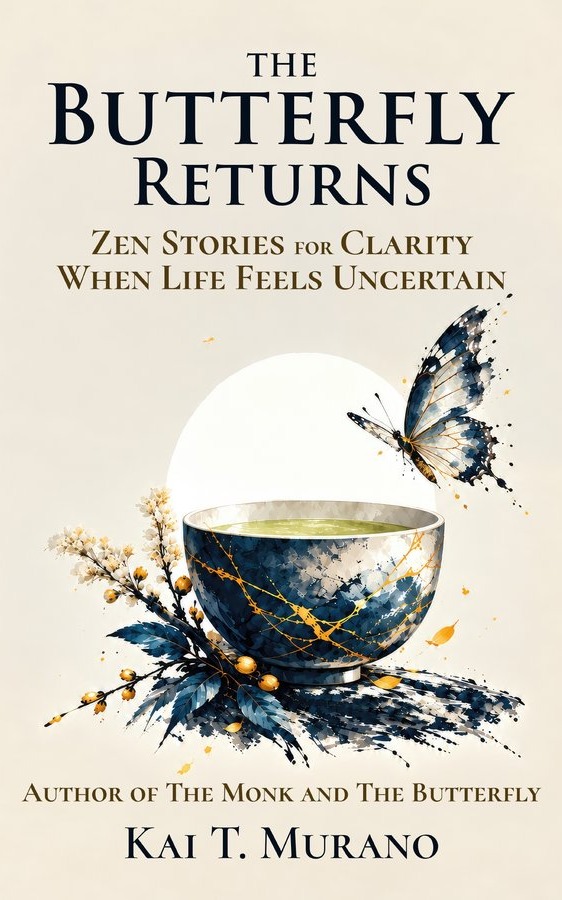
Readers of The Monk and The Butterfly may recognize something familiar in the title of this book.
The butterfly itself does not appear in these stories. In a sense, it does not need to.
In the earlier book, the butterfly became part of a moment of attention, a reminder that something small can interrupt the way we have been seeing the world. It was never only the butterfly that mattered. It was the pause around it. The noticing. The shift.
That is the butterfly that returns here.
It returns whenever someone sees an old problem differently. Whenever certainty softens. Whenever a person stops long enough to notice what fear, habit, pride, grief, or hurry has been hiding.
Sometimes that change leads forward.
Sometimes it leads back.
Sometimes it simply allows someone to remain where they are with a little more understanding.
You may recognize yourself in some of these stories. I hope you do. Others may seem to belong entirely to someone else until a day comes when they suddenly do not.
Stories can sit on a shelf for months or years and then, without having changed a word, meet us differently because we have changed.
Perhaps that is part of why we return to them.
And perhaps that is part of why the butterfly returns too.
Not to give us all the answers.
Just to remind us to look again.
Welcome.